




















.png)






.png)









CRM Data Enrichment
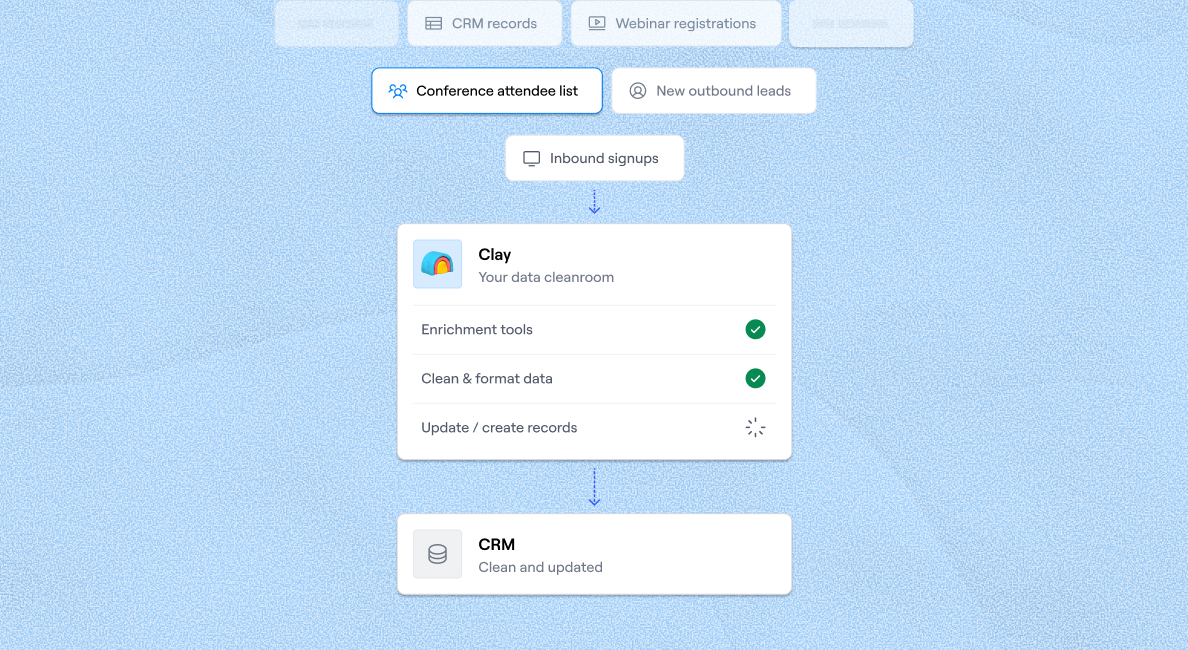
CRM data enrichment is the process of supplementing existing customer and prospect records with verified, up-to-date information from external sources. By filling in gaps such as job titles, company size, industry, technographics, and contact details, teams can build a more complete picture of every account in their pipeline. Rather than relying on whatever a lead provides at form fill, enriching CRM data ensures that sales and marketing teams operate with the context they need to prioritize deals, personalize outreach, and close revenue faster.
Key Benefits of CRM Data Enrichment
When organizations enrich CRM data consistently, the downstream effects touch nearly every revenue function. Clean, complete records reduce friction in handoffs between marketing and sales while enabling sharper segmentation and scoring.
- Data Quality: Eliminates incomplete or outdated records, giving reps confidence in the information they act on.
- Segmentation: Enables precise audience targeting by appending firmographic, technographic, and demographic attributes.
- Personalization: Provides the context needed to craft relevant messaging for each prospect or account.
- Productivity: Reduces time spent on manual research so reps can focus on selling instead of data entry.
- Lead Scoring: Strengthens scoring models with richer signals, helping teams prioritize high-intent accounts.
How to Implement CRM Data Enrichment
Implementing a reliable CRM data enhancement strategy requires thoughtful planning around data sources, automation, and governance. The steps below outline a practical path from audit to ongoing maintenance.
- 1. Audit Your Existing Data: Start by identifying which fields are most often incomplete or inaccurate. Understanding where the gaps are will help you prioritize which attributes to enrich first.
- 2. Define Your Ideal Data Model: Map out the fields that matter most for routing, scoring, and personalization. This becomes the blueprint for what your enrichment process should fill in.
- 3. Select Enrichment Providers: Evaluate providers based on coverage, accuracy, and integration depth with your CRM. Using a platform like Clay lets you waterfall across multiple data sources for the best match rates.
- 4. Automate Enrichment Workflows: Connect your enrichment tools directly to your CRM so new records are enhanced at the point of creation and existing records are refreshed on a schedule.
- 5. Validate and Monitor: Set up dashboards to track fill rates, accuracy scores, and data decay over time. Continuous monitoring ensures your CRM stays reliable as contacts change roles and companies evolve.
CRM Data Enrichment vs. Manual Data Entry
Both approaches aim to populate CRM records, but they differ dramatically in speed, accuracy, and scalability.
- CRM Data Enrichment uses automated tools and third-party data providers to append verified information to records in seconds. It scales effortlessly, reduces human error, and frees reps from tedious research. The tradeoff is that enrichment quality depends on the provider, so teams need to vet sources carefully and layer multiple providers for full coverage.
- Manual Data Entry relies on reps or operations staff to research and input data by hand. While it can be accurate for small datasets, it is slow, error-prone at scale, and pulls sellers away from revenue-generating activities. For growing teams, manual entry quickly becomes a bottleneck that limits pipeline velocity.
Tools and Technologies for CRM Data Enrichment
A modern enrichment stack combines multiple data providers with workflow automation to keep records fresh. The right tooling ensures your team can enrich CRM data without building brittle, custom integrations.
- Enrichment Platforms: Tools like Clay aggregate dozens of data providers into a single workflow, letting you waterfall across sources for the highest coverage and accuracy on every record.
- Data Providers: Specialized vendors supply firmographic, technographic, contact, and intent data. Salesforce data enrichment tools and native CRM connectors simplify syncing enriched fields back to your system of record.
- Automation and Integration: Workflow builders and native CRM integrations ensure enrichment runs automatically on triggers like new lead creation, deal stage changes, or scheduled refresh cycles.
Challenges and Solutions in CRM Data Enrichment
One of the biggest challenges is data decay. Contact information changes frequently as people switch jobs, companies rebrand, or phone numbers rotate. Without a recurring enrichment process, even a recently cleaned CRM degrades within months.
Another common issue is provider coverage gaps. No single source has complete data on every contact or company. The solution is to waterfall across multiple providers, using a platform that automatically queries the next source when the first returns no match. Pairing this with clear data governance policies ensures enriched records stay consistent and trustworthy across the organization.
Frequently Asked Questions about CRM Data Enrichment
How often should you enrich CRM data?
Most teams benefit from enriching new records in real time as they enter the CRM and running a full database refresh quarterly. High-velocity sales teams or those in fast-moving industries may refresh monthly to keep pace with job changes and company updates.
What types of data are typically added during CRM data enhancement?
Common enrichment fields include job title, seniority level, department, company revenue, employee count, industry, technology stack, funding history, and verified contact information such as direct phone numbers and email addresses.
Can CRM data enrichment integrate with my existing sales tools?
Yes. Most enrichment platforms offer native integrations with major CRMs like Salesforce and HubSpot, as well as sales engagement platforms. Clay, for example, connects directly to your CRM and pushes enriched data back into the right fields automatically, keeping your entire tech stack in sync.
Other terms
Awareness Buying Stage
The awareness stage is the first step in the buyer's journey, where a potential customer realizes they have a problem or an opportunity to explore.
FAB Technique
The FAB technique is a sales framework connecting product features to advantages and then to the specific benefits for the customer.
Account-Based Marketing
Account-Based Marketing (ABM) is a focused B2B strategy where marketing and sales collaborate to target and convert high-value accounts.
Lead Qualification
Lead qualification is the process of determining which prospects are most likely to become paying customers based on predefined criteria.
Cold Emailing
Cold emailing is sending unsolicited emails to potential customers you haven't contacted before, aiming to start a business conversation.
Customer Data Platform (CDP)
A Customer Data Platform (CDP) centralizes customer data from all sources to create a complete, unified profile for each individual customer.
Account Executive
An Account Executive (AE) is a sales professional responsible for closing new business deals and managing existing client relationships to drive revenue.
Consumer Relationship Management
Consumer Relationship Management (CRM) is a strategy for managing all of a company's relationships and interactions with its customers.
Buying Intent
Buying intent is the collection of online cues and behaviors that signal a prospect is actively researching and moving toward a purchase decision.
No Spam
“No Spam” is a commitment to sending only relevant, solicited messages. It means avoiding bulk, unwanted emails to respect the recipient's inbox.
Voice Broadcasting
Voice broadcasting is an automated system that delivers a pre-recorded voice message to a large list of phone numbers simultaneously.
GPCTBA/C&I
GPCTBA/C&I is a sales qualification framework for understanding a prospect's goals, plans, challenges, timeline, budget, and authority.
Dynamic Pricing
Dynamic pricing is a strategy where businesses set flexible prices for products or services based on current market demands and other factors.
Sales Pipeline
A sales pipeline is a visual representation of where prospects are in the sales process, from the first contact to the final sale.
Sales and Marketing Analytics
Sales and marketing analytics involves measuring and analyzing performance data to maximize effectiveness and optimize return on investment (ROI).
Business-to-Business (B2B)
Learn about B2B, including what is it, its key elements, the benefits of B2B partnerships, the differences between B2B and B2C, and strategies for effective marketing.
Buyer Intent Data
Learn about buyer intent data, including sourcing and interpreting buyer intent data, & key metrics in buyer intent analysis.
Point of Contact
A Point of Contact (POC) is the designated individual or department that serves as the main hub for information and communication on a matter.
Sales Lead
A sales lead is a potential customer—an individual or organization that has shown interest in your company's products or services.
Sales Kickoff
A sales kickoff (SKO) is an annual event for a sales team to celebrate wins, align on goals, and get motivated for the upcoming year.
Smile and Dial
"Smile and dial" is a high-volume sales tactic where reps make numerous cold calls from a list, often with little to no prior research.
Account Management
Account management is the post-sales practice of building and nurturing long-term relationships with a company's most valuable clients.
Integration Testing
Integration testing is a software testing phase where individual modules are combined and tested together to verify their interaction.
Sales Enablement Technology
Sales enablement technology refers to software and tools that equip sales teams with the resources they need to close more deals efficiently.
Account-Based Marketing Software
Account-Based Marketing (ABM) software helps teams coordinate personalized marketing and sales efforts to land high-value customer accounts.
Big Data
Learn about big data, including understanding big data characteristics, benefits of leveraging big data, & challenges in managing big data.
Channel Partner
A channel partner is a company that works with a manufacturer or producer to market and sell their products, software, or services to customers.
Employee Engagement
Employee engagement is the emotional commitment an employee has to their organization, motivating them to contribute to the company's success.
Customer Acquisition Cost
Customer Acquisition Cost (CAC) is the total cost a business spends to gain a new customer. It includes all sales and marketing expenses.
Email Verification
Email verification is the process of confirming that an email address is valid and deliverable, which helps improve campaign performance.
Marketo
Marketo is a marketing automation platform used by B2B marketers to manage lead generation, nurturing, email marketing, and analytics.
B2B Data Enrichment
Learn about B2B data enrichment, including benefits of B2B data enrichment, implementing B2B data enrichment strategies, B2B data enrichment vs. data cleaning.
Revenue Intelligence
Revenue intelligence is the process of collecting and analyzing customer data to provide insights that help sales teams make smarter decisions.
Cross-Site Scripting
Cross-Site Scripting (XSS) is a web security vulnerability that allows attackers to inject malicious scripts into trusted websites.
Event Marketing
Event marketing is a strategy where brands engage directly with target audiences through live events like trade shows, conferences, or webinars.
Site Retargeting
Site retargeting is a marketing strategy that shows ads to people who have previously visited your website but left without converting.
Sales Coach
A sales coach is a mentor who trains and guides sales reps to enhance their skills, boost performance, and ultimately close more deals effectively.
Intent leads
Intent leads are prospects who show buying signals through their online actions, indicating they're actively looking to make a purchase.
Sales Operations Analytics
Sales operations analytics is the practice of analyzing sales data to improve the efficiency and effectiveness of the entire sales process.
Net New Business
Net new business is revenue from customers who have never purchased from your company before. It’s a crucial indicator of sustainable growth.
B2B Data
Learn about B2B data, including sources and types of B2B data, leveraging B2B data for sales success, & ensuring the accuracy of B2B data.
Event Tracking
Event tracking is the method of collecting data on specific user actions, or 'events,' on a website or app, such as clicks or downloads.
Outbound Lead Generation
Outbound lead generation means proactively reaching out to potential customers who haven't yet expressed interest to introduce them to your brand.
Scrum
Scrum is an agile framework that helps teams structure and manage their work through a set of values, principles, and practices.
Single Page Applications
A Single Page Application (SPA) is a web app that interacts with the user by dynamically rewriting the current page rather than loading new pages.
Buying Committee
A buying committee is a group of stakeholders within an organization who are jointly responsible for making major purchasing decisions.
B2B Intent Data
Learn about B2B intent data, including how B2B intent data enhances sales strategies, sources of B2B intent data, leveraging B2B intent data for competitiveness.
Email Marketing
Email marketing is a digital strategy where businesses send targeted emails to prospects and customers to build relationships and drive sales.
Letter of Intent
A Letter of Intent (LOI) is a document declaring the preliminary commitment of one party to do business with another, outlining the chief terms.
Intent Data
Intent data tracks a user's online behavior—like searches and site visits—to identify signals that they are ready to make a purchase.
Monthly Recurring Revenue (MRR)
Monthly Recurring Revenue (MRR) is the predictable, recurring income a business expects to receive each month from all active subscriptions.
NoSQL
NoSQL ("Not only SQL") databases offer a flexible alternative to relational models, excelling at managing large and unstructured data sets.
Behavioral Analytics
Learn about behavioral analytics, including implementing behavioral analytics successfully, & key metrics in behavioral analytics.
Sales Demo
A sales demo is a presentation where a sales rep shows a prospect how a product or service works and solves their specific problems.
B2B Intent Data Providers
Learn about B2B intent data providers, including evaluating intent data quality, leveraging intent data for growth, & B2B intent data: key providers comparison.
Sandboxes
A sandbox is an isolated testing environment where new or untrusted code can be run safely without affecting the host device or network.
Precision Targeting
Precision targeting is a marketing strategy that uses data to identify and reach a highly specific audience most likely to convert.
Lead Enrichment
Lead enrichment adds third-party data to your raw lead lists, creating fuller prospect profiles for more effective and personalized outreach.
Sales Intelligence
Sales intelligence is technology that gathers and analyzes data to help salespeople find and understand prospects and existing clients.
End of Day
End of Day (EOD) refers to the close of business hours. It's a common deadline for tasks and reports to be completed before the workday ends.
Account
An account is a company or organization that you're targeting for sales. It can be a prospective, current, or even a past customer.
GTM
A go-to-market (GTM) strategy is an action plan that outlines how a company will reach target customers and achieve a competitive advantage.
Sales Territory
A sales territory is a specific group of customers or a geographic area that a salesperson or sales team is responsible for managing.
Persona-Based Marketing
Persona-based marketing uses fictional customer profiles, or personas, to create targeted messaging for specific audience segments.
Buyer’s Remorse
Buyer’s remorse is the sense of regret or anxiety that can arise after making a purchase, often questioning if it was the right decision.
Operational CRM
An Operational CRM is a system that automates and improves customer-facing business processes like sales, marketing, and customer service.
SFDC
SFDC stands for Salesforce Dot Com, a popular cloud-based CRM platform that helps companies manage their customer interactions and data.
Sales Metrics
Sales metrics are quantifiable data points that track and measure a sales team's performance against specific goals and objectives.
Ramp Up Time
Ramp-up time is the period a new hire takes to get fully up to speed and become a productive member of your go-to-market team.
Marketing Qualified Lead (MQL)
A Marketing Qualified Lead (MQL) is a prospect who has shown interest based on marketing efforts but isn't yet ready for a sales conversation.
Load Testing
Load testing is a type of performance testing that determines how a system behaves under both normal and anticipated peak load conditions.
Lead Generation Funnel
A lead generation funnel is a systematic process that guides potential customers from initial awareness of your brand to becoming qualified leads.
X-Sell
X-Sell, or cross-selling, is a sales strategy of selling additional, related products or services to an existing customer base.
HubSpot
HubSpot is a customer relationship management (CRM) platform with tools for marketing, sales, and service, all aimed at helping businesses grow.
Customer Retention
Customer retention refers to the strategies and activities a company uses to prevent customer churn and encourage them to continue buying.
Marketing Qualified Account
A Marketing Qualified Account (MQA) is a target company that has shown significant engagement, indicating it's ready for the sales team to pursue.
RESTful API
A RESTful API is a web service interface that uses HTTP requests to access and use data, adhering to the constraints of REST architecture.
Docker
Docker is a tool that packages applications and their dependencies into isolated environments called containers for easy deployment and scaling.
Objection Handling in Sales
Objection handling in sales is the process of responding to a prospect's concerns about a product or service to move the deal forward.
Stress Testing
Stress testing is a type of software testing that determines a system's robustness by pushing it beyond its normal operational capacity.
Warm Outbound
Warm outbound is a sales strategy for contacting prospects who've shown interest in your brand through prior engagement, like website visits.
Website Visitor Tracking
Website visitor tracking collects and analyzes data on user behavior to understand their journey and improve the overall user experience.
Request for Information
A Request for Information (RFI) is a formal process for gathering information from potential suppliers before issuing a more detailed proposal.
Enterprise Resource Planning
Enterprise Resource Planning (ERP) is a system of integrated software that businesses use to manage and automate their core day-to-day processes.
Account-Based Sales Development
Account-Based Sales Development (ABSD) is a focused strategy where SDRs target key stakeholders within specific, high-value accounts.
Marketing Play
A marketing play is a repeatable tactic used to achieve a specific marketing goal, like generating leads or driving engagement.
Business Continuity
Learn about business continuity, including understanding key components, steps to ensure continuity, common challenges, & best practices.
Bounce Rate
Learn about bounce rate, including understanding bounce rate implications, key factors affecting bounce rate, & reducing your bounce rate effectively.
Sales Development
Sales development is the process of identifying and qualifying potential customers to create a pipeline of sales-ready leads for closers.
No Cold Calls
No Cold Calls is a sales strategy that replaces unsolicited calls with warm outreach to prospects who have already demonstrated interest.
Sales Coaching
Sales coaching is a process where managers help reps improve their skills and performance through personalized feedback, training, and guidance.
Pipeline Coverage
Pipeline coverage is a key sales metric. It's the ratio of your total open pipeline value to your sales quota for a specific period.
Marketing Mix
The marketing mix is the set of marketing tools a company uses to sell products, defined by the 4Ps: Product, Price, Place, and Promotion.
Contact Discovery
Contact discovery is the process of finding accurate contact details for potential leads, including names, emails, phone numbers, and job titles.
Representational State Transfer Application Programming Interface
A Representational State Transfer (REST) API is a web service that uses a simple, stateless architecture for systems to communicate online.
Lead Scoring
Lead scoring is the process of assigning points to leads based on their attributes and actions to determine their sales-readiness.
Retargeting Marketing
Retargeting marketing is a digital advertising strategy that targets users who have previously interacted with your website or brand online.
Sales Enablement Content
Sales enablement content refers to the materials and tools that empower your sales team to engage prospects and close deals more efficiently.
Webhooks
Webhooks are automated messages sent by an app when a specific event occurs. They push real-time data to another app's unique URL.
Lead List
A lead list is a curated database of potential customers (leads) with contact information and other key data for sales and marketing outreach.